Short answer: a small UPS keeps a Standard kit online for roughly 15 to 35 minutes, enough for a blip or a short outage. For hours of backup you need a power station with a pure-sine AC outlet, sized for about 100 W on a Standard kit or 50 W on a V5 (the top of each kit’s spec-sheet average). A Starlink Mini is the easiest to run off-grid: at 25 to 40 W it works from DC power stations and Mini-specific batteries, many with no inverter at all.
To match a power station to your kit, see power stations by Starlink model below.
Last checked October 13, 2026.
As an Amazon Associate I earn from qualifying purchases.
See every Starlink power guide, product and the calculator on our Starlink power hub.
How much power each kit uses
Swipe or scroll sideways to see the full table. With a keyboard, focus the table area and use the arrow keys.
| Kit | Average draw (Starlink spec sheet) | How it’s powered |
|---|---|---|
| Starlink Mini | 25–40 W | DC input (12–48 V), or USB-C PD with Starlink’s USB-C to barrel jack cable (needs a 100 W, 20 V/5 A source) |
| Standard and Standard 4 | 75–100 W | AC power supply |
| V5 | 35–50 W | AC power supply |
Sources: Starlink spec sheets for Mini, Standard, Standard 4 and V5. Starlink doesn’t publish peak or snow-melt wattage, so plan for the top of each range, or a little above it in snowy weather.
Working out runtime
Divide the battery’s watt-hours by the kit’s draw, then knock off some losses: roughly 15% when you go through an AC inverter, and about 10% on a direct DC or USB-C connection. A 500 Wh power station running a Standard kit at 100 W gives about 4 to 4.5 hours. The same battery runs a Mini at 30 W for well over 10 hours. Treat any “up to X hours” claim on a listing as a best case at low draw.
Short outages: a UPS
A desktop UPS sits between the wall and your Starlink power supply and takes over instantly when the power drops. The small lead-acid units below run a Standard kit for only about 15 to 35 minutes, so they’re for brief outages, not a night without power. They last roughly an hour on a V5 or Mini. All three use stepped or simulated sine output, and Starlink doesn’t certify UPS waveforms.
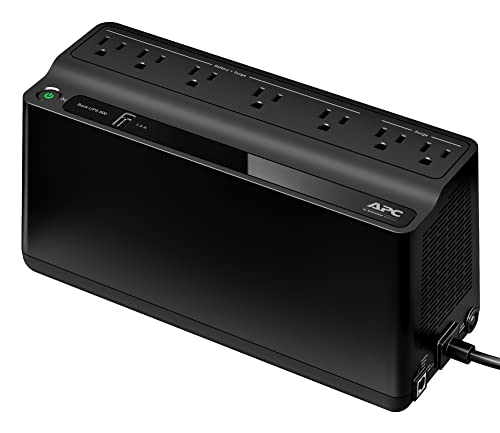
APC Back-UPS BE600M1
Rides out short outages on a home Starlink kit
Check the fitShort outage bridge: about 23–35 min for a Standard kit (75–100 W), about 50–90 min for Starlink Mini or V5 (estimates from APC's runtime chart). Stepped-sine output; not a long-outage solution.
Check price on AmazonAs an Amazon Associate I earn from qualifying purchases.
Before you buy
Product source · checked 2026-10-10. Amazon shows current offers. Research-based guidance, not a hands-on test.

CyberPower ST625U
Rides out brief outages on a home Starlink kit
Check the fitShort outage bridge: roughly 15–25 min for a Standard kit (75–100 W), about 40–60 min for Starlink Mini or V5 (estimates). Simulated-sine output.
Check price on AmazonAs an Amazon Associate I earn from qualifying purchases.
Before you buy
Product source · checked 2026-10-10. Amazon shows current offers. Research-based guidance, not a hands-on test.

CyberPower EC850LCD
Rides out short outages on a home Starlink kit
Check the fitAbout 20–30 min for a Standard kit on battery. Plug Starlink into a battery-backup outlet, not an ECO outlet. Simulated-sine output.
Check price on AmazonAs an Amazon Associate I earn from qualifying purchases.
Before you buy
Product source · checked 2026-10-10. Amazon shows current offers. Research-based guidance, not a hands-on test.
Hours of backup for Standard and V5 kits: AC power stations
For longer outages, a power station with a pure-sine AC outlet runs the Starlink power supply just as the wall would. Size it by watt-hours, using about 100 W for a Standard kit and 50 W for a V5, the top of each kit’s spec-sheet average.

Anker SOLIX C1000
Long backup for Standard 4, V5 or Mini
Check the fitRuns Standard 4 (about 9–12 h), V5 (about 18–26 h) or Mini from its AC outlets; Mini can also use the 100 W USB-C port with Starlink's Mini USB-C cable (needs 100W, 20V/5A). Includes a car charging cable.
Check price on AmazonAs an Amazon Associate I earn from qualifying purchases.
Before you buy
Product source · checked 2026-10-13. Amazon shows current offers. Research-based guidance, not a hands-on test.

Jackery Explorer 1000 v2
Long backup for Standard 4, V5 or Mini
Check the fitRuns Standard 4 (about 9–12 h), V5 or Mini via AC; Mini can also use the 100 W USB-C port with Starlink's Mini USB-C cable (needs 100W, 20V/5A), not the 30 W one.
Check price on AmazonAs an Amazon Associate I earn from qualifying purchases.
Before you buy
Product source · checked 2026-10-13. Amazon shows current offers. Research-based guidance, not a hands-on test.
Starlink Mini only: DC power stations and Mini batteries
These are for Starlink Mini only. They have no AC outlet, or their output is built around the Mini’s DC input, so they can’t run a Standard, Standard 4 or V5 kit. Most are third-party products made for the Mini, not by Starlink. Runtimes below are worked out from Starlink’s 25–40 W average, not from the makers’ headline claims.

Anker SOLIX C200 DC (192Wh)
Half-day Starlink Mini power without an AC outlet
Check the fitDC-only (no AC outlet): Starlink Mini only, via its 140W USB-C port and Starlink's Mini USB-C cable (needs 100W, 20V/5A); about 4–7 h. Cannot run Standard, Standard 4 or V5 kits.
Check price on AmazonAs an Amazon Associate I earn from qualifying purchases.
Before you buy
Product source · checked 2026-10-10. Amazon shows current offers. Research-based guidance, not a hands-on test.

Anker SOLIX C300 DC (288Wh)
Day-long Starlink Mini power without an AC outlet
Check the fitDC-only (no AC outlet): Starlink Mini only, via its 140W USB-C port and Starlink's Mini USB-C cable (needs 100W, 20V/5A); about 6–10 h. Cannot run Standard, Standard 4 or V5 kits.
Check price on AmazonAs an Amazon Associate I earn from qualifying purchases.
Before you buy
Product source · checked 2026-10-10. Amazon shows current offers. Research-based guidance, not a hands-on test.

GENDOME StarGrid 288Wh kit (third-party)
All-in-one Starlink Mini battery kit
Check the fitThird-party (not made by Starlink). About 6–10 h for Starlink Mini (25–40 W average; math, not a test).
Check price on AmazonAs an Amazon Associate I earn from qualifying purchases.
Before you buy
Product source · checked 2026-10-10. Amazon shows current offers. Research-based guidance, not a hands-on test.
USB-C power banks and Mini power cables
The Mini can run from USB-C, but only from a port that holds 100 W (20 V/5 A) and through a USB-C to barrel jack cable (Starlink Mini spec sheet). The laptop power bank shown below has a port rated that high, but its maker does not establish sustained performance with a Starlink Mini; treat that compatibility as unconfirmed. The cables are third-party, and Starlink’s IP67 rating applies only with Starlink’s own cable.

Anker Laptop Power Bank (25K, 165W)
General USB-C power bank; Starlink Mini use unconfirmed
Check the fitUnconfirmed for Starlink Mini; needs a sustained 100 W (20V/5A) port.
Check price on AmazonAs an Amazon Associate I earn from qualifying purchases.
Before you buy
Product source · checked 2026-10-10. Amazon shows current offers. Research-based guidance, not a hands-on test.

STARGEAR Mini 12V car cable, 10 ft (third-party)
Runs a Starlink Mini from a vehicle 12V socket
Check the fitThird-party 12V cable for Starlink Mini; Starlink's IP67 rating applies only with Starlink's own cable. Expect about 0.4 V drop at 5 A; best with the engine running.
Check price on AmazonAs an Amazon Associate I earn from qualifying purchases.
Before you buy
Product source · checked 2026-10-10. Amazon shows current offers. Research-based guidance, not a hands-on test.

STARGEAR Mini 12V car cable, 16.4 ft (third-party)
Longer 12V run for a Starlink Mini
Check the fitThird-party 12V cable for Starlink Mini; Starlink's IP67 rating applies only with Starlink's own cable. Longer run (about 0.65 V drop at 5 A) is riskier at 12 V; prefer the 10 ft.
Check price on AmazonAs an Amazon Associate I earn from qualifying purchases.
Before you buy
Product source · checked 2026-10-10. Amazon shows current offers. Research-based guidance, not a hands-on test.
Power stations by Starlink model (criteria, not a ranking)
Pick a station by what your kit needs: a Mini needs one USB-C port that holds 100 W (20 V/5 A) or a 12–48 V DC output, while Standard 4 and V5 kits need a pure-sine AC outlet. Then size the watt-hours for the hours you want; we haven’t timed these in our own tests.
The criteria we use
- Enough usable watt-hours for your hours at the kit’s average draw.
- Pure-sine AC output with margin over the kit’s draw (Standard 4 and 4 X 75–100 W, Actuated 50–75 W, V5 35–50 W).
- For Mini: 100 W on a single USB-C port, or a 12–48 V DC output (Mini 25–40 W per its spec sheet; Starlink’s Help Center lists 20–40 W).
- UPS or pass-through switchover only where the maker documents it.
- Sold by Amazon.com or the brand’s own store.
Draw figures are from the Starlink Help Center (idle 15 W for Mini, 20 W for Standard 4/4 X and Actuated) and, for V5, its spec sheet.
Rated watt-hours for a target runtime
Swipe or scroll sideways to see the full table. With a keyboard, focus the table area and use the arrow keys.
| Hours | Mini at 30 W, DC (90%) | V5 at 40 W, AC (85%; spec sheet: 35–50 W) | Standard 4 at 90 W, AC (85%) |
|---|---|---|---|
| 4 h | about 135 Wh | about 190 Wh | about 425 Wh |
| 8 h | about 270 Wh | about 375 Wh | about 850 Wh |
| 12 h | about 400 Wh | about 565 Wh | about 1,270 Wh |
Math, not a test: rated Wh ≈ hours × watts ÷ efficiency. Run your own numbers in the power hub.
Starlink Mini
A mid-size station with a full-power USB-C port suits the Mini; the DC stations above also work.

Jackery Explorer 500 v2 (512Wh)
Mid-size station for Starlink Mini
Check the fitRuns Starlink Mini via the USB-C1 port (100W, 20V/5A; USB-C2 is only 30W) with Starlink's Mini USB-C cable (needs 100W, 20V/5A), or from its AC outlet.
Check price on AmazonAs an Amazon Associate I earn from qualifying purchases.
Before you buy
Product source · checked 2026-10-13. Amazon shows current offers. Research-based guidance, not a hands-on test.
V5 and Standard 4
For a night or more, look for a station around 1,000 Wh with pure-sine AC; any card above that meets those criteria fits Standard 4, V5 and Mini.
When a UPS is enough
A UPS covers blips and outages under about half an hour on a Standard kit. For anything longer, use a station.
Recharging and vehicles
To refill a station off-grid, see our Starlink solar guide. For a van, RV or boat house battery, see our Starlink 12V guide. Related: power supplies, power consumption, Mini portable power, Mini car adapter and the cable guide.
Before you buy
- Match the output to your kit: AC for Standard, Standard 4 and V5; DC or 100 W USB-C PD for the Mini.
- Size for the top of Starlink’s range, not the listing’s best case.
- For a vehicle, keep 12 V cable runs short; voltage drop rises with length.
- See our Starlink Mini guide and the accessory compatibility guide for the rest of your setup.